Skip to content

What to Check Before Paying for a New Website

Paying for a new website is a serious business decision. A good website can help you win enquiries, explain your services clearly and support your marketing for years. A poor one can leave you with a nice-looking page that is hard to update, difficult to rank, expensive to maintain and unclear for customers. Before you agree to a quote, there are a few things worth checking properly.

Website proposal, checklist and laptop showing a new website design before purchase
A new website should be treated as a business investment, not just a design purchase.

Start by Checking What the Website Is Meant to Do

Before comparing prices, make sure you know what the website is supposed to achieve. A brochure website, lead generation website, ecommerce store, booking website and membership platform all need different planning. The cheapest quote may only look cheap because it does not include the things your business actually needs.

For most service businesses, a website should help visitors understand who you are, what you offer, where you work, why they should trust you and what they should do next. If the proposal only talks about design and page count, it may not be thinking far enough ahead.

This is why professional web design starts with purpose. The layout, copy, images, calls to action and page structure should all support the reason the website exists. A site built only around appearance can look good on launch day but still fail to generate enquiries.


Ask for a Clear Scope Before You Pay

A proper website quote should explain exactly what is included. If the scope is vague, it becomes much easier for misunderstandings to appear later.

At minimum, you should know:

  • How many pages are included
  • Whether the design is bespoke or template-based
  • Whether copywriting is included
  • Who supplies images
  • Whether contact forms are included
  • Whether SEO basics are included
  • How many rounds of revisions are allowed
  • What happens after the website goes live

There is nothing wrong with a simple website package if that is what you need. The issue is not simplicity. The issue is paying for one thing while assuming you are getting another.

A good proposal should remove uncertainty. You should be able to read it and understand what will be built, what it will cost and what is expected from you.

Check Whether Content Is Included

Content is one of the most common causes of website delays. Many businesses accept a quote assuming the web designer will write the wording, only to find later that the client is expected to provide all of it.

Supplying your own content can work if you are comfortable writing clearly about your services. For many businesses, though, it is harder than expected. A website needs headings, service descriptions, calls to action, trust-building content and answers to the questions customers usually ask before buying.

If content is not included, ask what support is provided. Will the designer give you a page structure? Will they advise on what each page should say? Will they edit what you provide? Will they optimise the content for search engines?

This matters because content and structure affect SEO. A website can be visually polished but still struggle to rank if the pages are thin, vague or missing the terms your customers actually search for. If search visibility is important, ask whether SEO services are part of the project or whether they are quoted separately.


Confirm Who Owns the Website

Before paying for a website, check who owns the domain, hosting account, website files, content and design once the work is complete.

You should know whether:

  • The domain is registered in your name
  • You will have administrator access to the website
  • You can move the website to another host if needed
  • You own the written content and images supplied for the site
  • There are any licence restrictions on the design or plugins used

This is especially important when a website is sold on a monthly subscription. Some arrangements are perfectly fair, but you need to understand what happens if you stop paying. Do you keep the site? Can you export it? Do you lose access? Are there cancellation terms?

A good supplier should be clear about this. If ownership is difficult to understand before you pay, it is worth asking more questions.
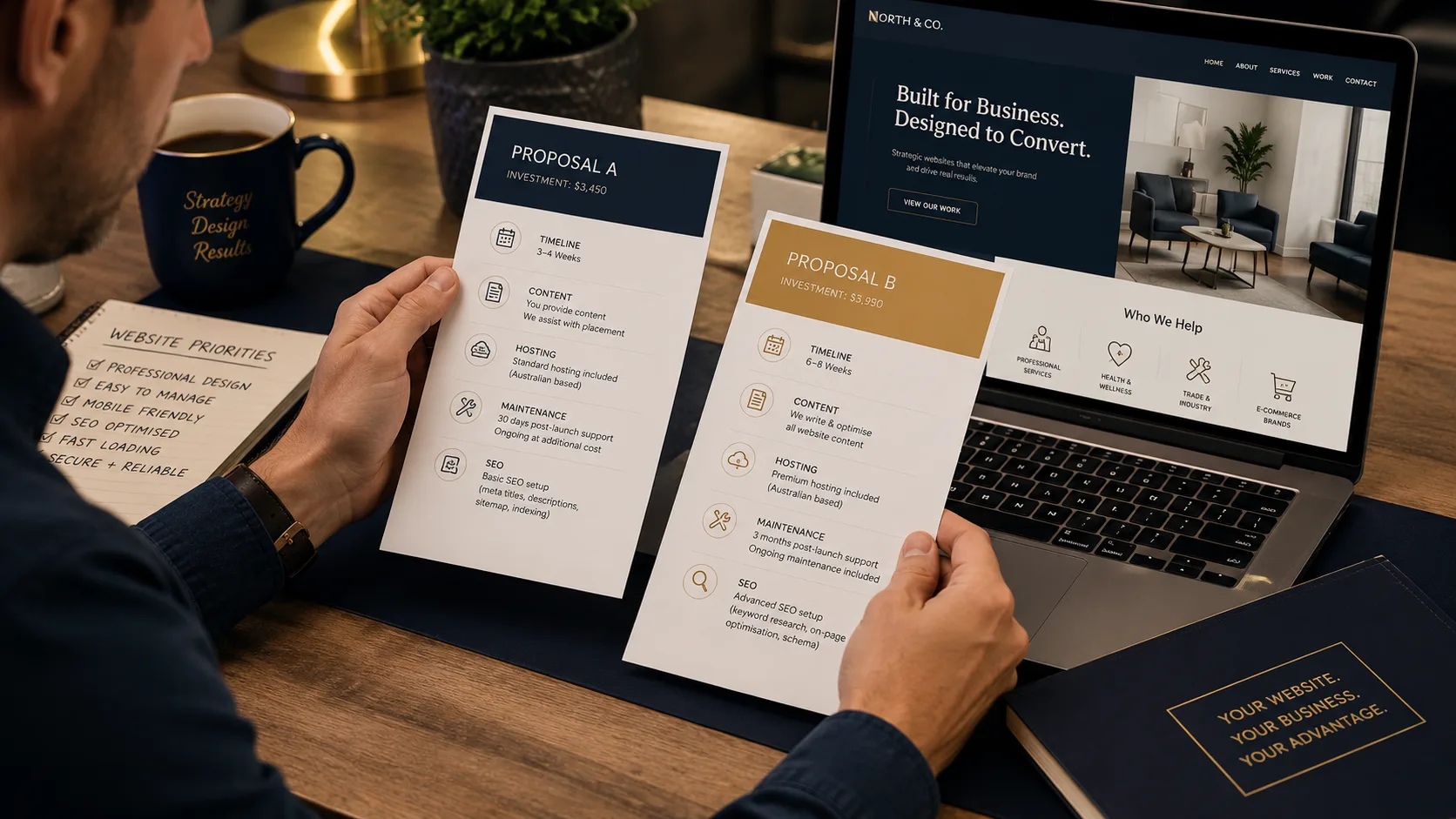
Business owner reviewing a website design proposal, mockups and project notes
Review the scope, timeline, ownership, revisions and support before agreeing to a website project.

Check How the Website Will Be Built

Not all websites are built the same way. Two quotes can describe a “professional website” but involve very different levels of work.

Some websites are built using pre-made templates with limited customisation. Others are custom designed and developed around the business. Some rely heavily on page builders and third-party plugins. Others use cleaner code and more controlled development. None of these options are automatically wrong, but they are not the same product.

If you are paying for a serious business website, ask how it will be built and why that approach is suitable. A custom WordPress development project should give you a site that is easier to manage, better structured and more suitable for long-term growth than a rushed template setup.

You do not need to understand every technical detail. You do need to understand whether the website is being built for your business or simply assembled from whatever is quickest.


Make Sure Mobile and Speed Are Included

A modern website must work properly on mobile. That should not be an optional extra. Many visitors will view your site on a phone first, especially if they are searching for a local service, comparing providers or looking for a quick way to contact you.

Ask whether the site will be tested on different screen sizes. Check whether forms, menus, buttons and images will be properly optimised for mobile users.

Speed also matters. Slow websites frustrate visitors and can reduce enquiries. They can also make SEO harder. Large image files, unnecessary scripts, bloated page builders and too many plugins can all affect performance.

If performance is important to you, ask the supplier how they approach page speed, image optimisation and Core Web Vitals. If the answer is vague, that is worth noting.


Ask What SEO Means in the Quote

Many website quotes mention SEO, but the word can mean very different things. Sometimes it means the site will have basic title tags and descriptions. Sometimes it includes proper keyword research, service page planning, internal linking, technical SEO, local SEO and content structure.

Before you pay, ask what is actually included. A sensible SEO foundation should usually cover:

  • Page titles and meta descriptions
  • Clear heading structure
  • Search-friendly URLs
  • Image alt text
  • Fast, mobile-friendly pages
  • Internal links between relevant pages
  • Submission to Google Search Console
  • Basic schema where appropriate

If you are targeting local customers, you may also need location pages, Google Business Profile optimisation and content that matches local search intent. For example, a business targeting Hertfordshire may benefit from a properly written local page such as web design in St Albans or SEO services in St Albans, rather than trying to make every location fit onto one generic page.

Understand the Revision Process

Most website projects involve some changes. That is normal. The important thing is knowing how revisions are handled before the project begins.

Ask how many review stages are included, how feedback should be provided and what counts as a revision. A small wording change is different from changing the entire structure of a page after it has been built.

A clear revision process protects both sides. You know when you can give feedback, and the designer can keep the project moving without endless changes that were never part of the original scope.
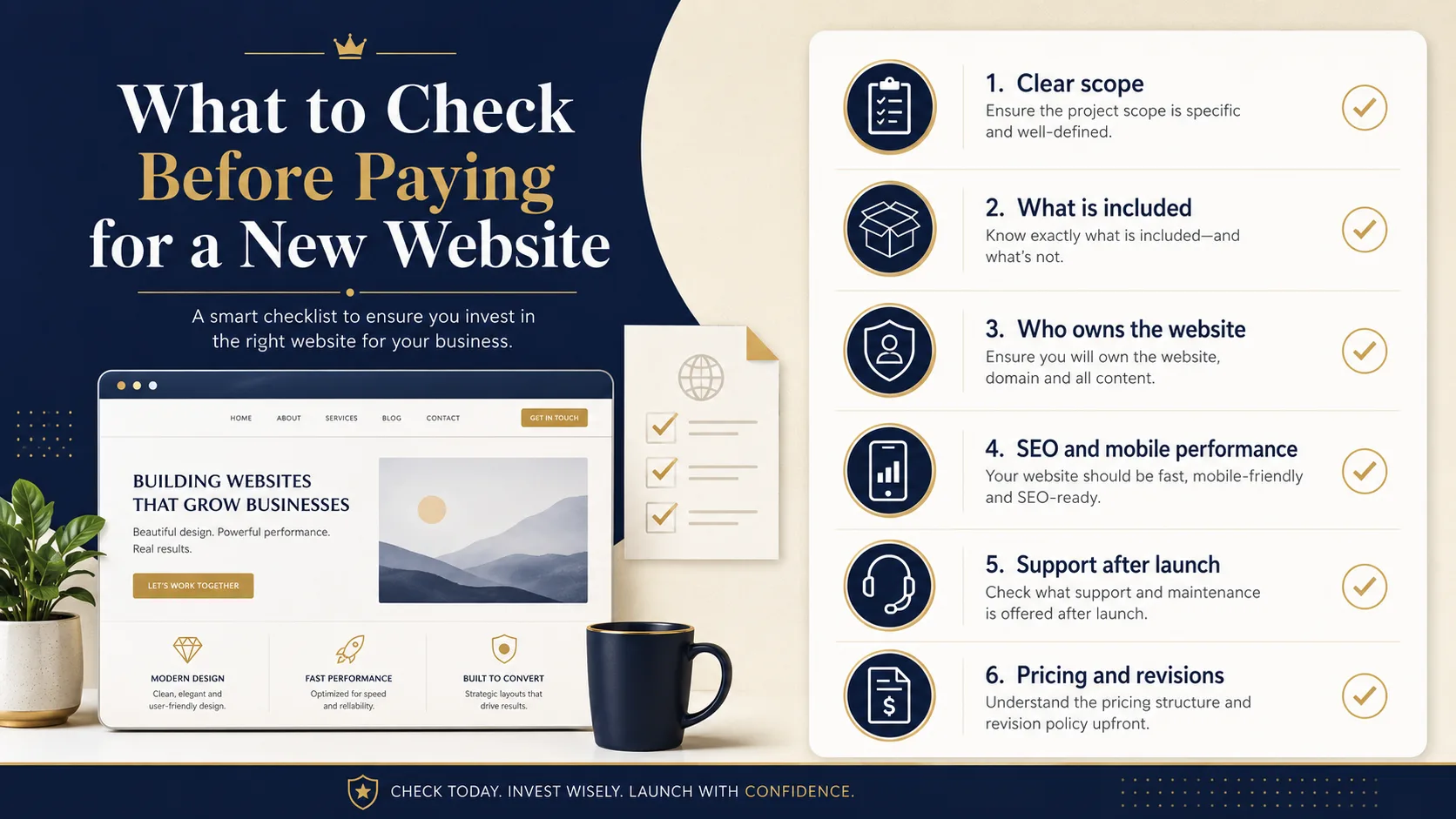
Infographic showing what to check before paying for a new website
A useful website checklist should cover scope, inclusions, ownership, SEO, performance, support, pricing and revisions.

Check What Happens After Launch

A website does not stop needing attention once it goes live. WordPress updates, plugin updates, backups, security checks, performance monitoring and small content changes all need handling.

Ask whether any post-launch support is included. For example, do you get a handover? Is training provided? Are bugs fixed for a short period after launch? What happens if a form stops working, a plugin update causes a problem or you need a small change?

Many businesses do not want to manage the technical side themselves. In that case, a website maintenance plan may be worth arranging from the start. It is usually easier to prevent problems than to fix them after something has broken.


Compare Value, Not Just Price

It is sensible to compare prices, but price alone does not tell you much unless the quotes include the same things. One quote might include planning, design, development, SEO setup, copywriting guidance, testing, launch support and maintenance advice. Another might include only a basic page build.

When comparing website quotes, look at what each one gives you in practical terms:

  • Will the site help customers understand your services?
  • Will it be easy to update?
  • Will it be fast and mobile-friendly?
  • Will it be structured properly for search?
  • Will it make enquiries easier?
  • Will there be support after launch?

If you are unsure what a fair price looks like, our guide to how much a website costs in the UK explains the main factors that affect website pricing.

Look at Previous Work

Before choosing a supplier, look at examples of previous projects. A portfolio will not tell you everything, but it gives you a sense of the design quality, range of work and level of detail.

When reviewing a website portfolio, do not only look at whether the screenshots are attractive. Ask whether the sites appear clear, easy to use and suitable for the type of business they represent. A good website should feel appropriate for the client, not just impressive in isolation.


Make Sure the Website Is Built Around Enquiries

If you are a service business, your website should make it easy for visitors to enquire. That means clear calls to action, visible contact routes, sensible page structure and enough trust signals to help people feel comfortable getting in touch.

This is one of the most important checks before you pay. A site can look modern and still fail if visitors do not know what to do next. If your current site already gets traffic but does not generate leads, read our guide on why websites get visitors but no enquiries.

If you are starting a new business and need more than a standalone website, it may also be worth considering a wider package covering branding, web design, SEO foundations and marketing setup. Our complete business start-up package is designed for that type of project.

Final Thoughts

Before paying for a new website, take time to understand exactly what you are buying. A good website project should have a clear scope, sensible structure, proper ownership terms, mobile and SEO considerations, realistic pricing and support after launch.

If you are still comparing options, our main web design services page explains how Webtex plans and builds professional business websites around clarity, trust and enquiries.

The right website supplier will not rush you into a decision. They will explain what is included, point out anything that may affect the project and help you choose the option that makes sense for your business.

Planning a New Website?

Webtex can help you understand what you need, what should be included and what level of website is right for your business.
Ask Webtex About Your Website

TS
Tim Shortt

Senior Developer & Director, Webtex Digital Services. Over 13 years building WordPress websites and digital marketing solutions for businesses across Hertfordshire and the UK.

Why Your Website Gets Visitors but No Enquiries

Getting traffic to your website is only half the job. If people are landing on your pages but not calling, emailing, filling in forms or requesting quotes, the problem is usually not visibility. It is what happens after the visitor arrives. This article explains why websites get visitors but no enquiries, and what to fix first if you want your website to generate business.

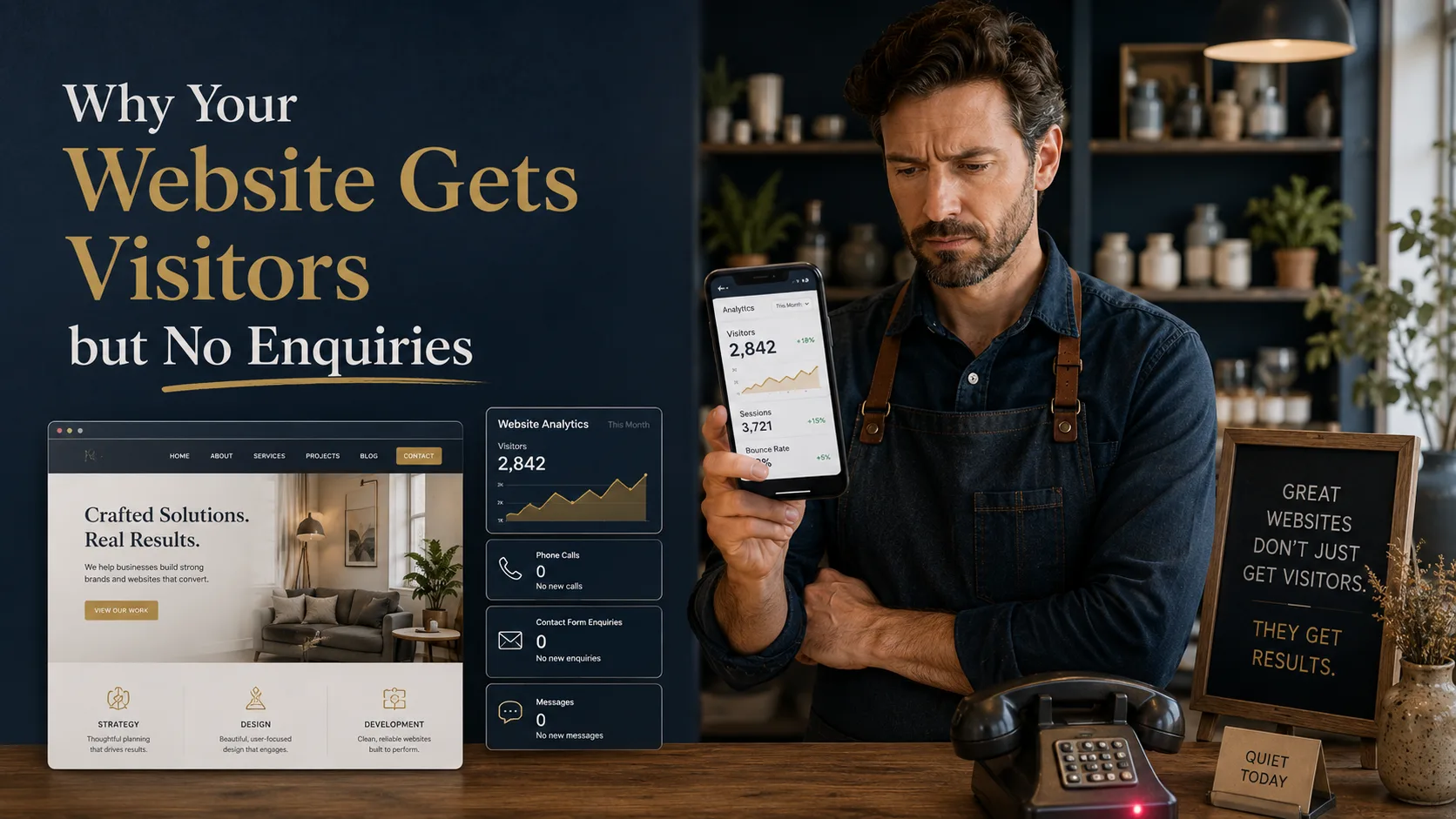
Business owner reviewing website analytics with no new enquiries or phone calls
Traffic is useful only when visitors understand what to do next and feel confident enough to contact you.

Traffic Alone Does Not Mean Your Website Is Working

Many business owners look at their analytics and assume that more visitors will automatically mean more enquiries. Sometimes it does. More often, it reveals a different problem. People are finding the website, but something on the page is stopping them from taking the next step.

That is why a website should not be judged only by traffic. A more useful question is whether the right visitors are turning into useful actions. Those actions might be phone calls, contact form submissions, quote requests, bookings, product purchases or email sign-ups. If those things are not happening, the website needs to be looked at from a conversion point of view.

This is where good web design matters. Design is not just about how a site looks. It controls how quickly people understand your offer, how much they trust you, how easy it is to move around the site and whether they know what to do next.


Your Message Is Not Clear Enough

One of the most common reasons visitors leave without enquiring is simple: they do not understand what you do quickly enough.

This often happens when the homepage headline is too vague, the service pages talk too much about the company instead of the customer, or the wording sounds impressive but does not answer the visitor’s real question. Someone arriving from Google is usually trying to work out three things:

  • Does this business offer what I need?
  • Can I trust them to do it properly?
  • What should I do next?

If the page does not answer those questions quickly, the visitor may go back to the search results and choose someone else. This is especially important for service businesses, where visitors are often comparing several providers before making contact.

A good test is to show your homepage or main service page to someone who does not already know your business. Give them five seconds, then ask what you do and who you help. If they hesitate, the page probably needs clearer wording.


The Call to Action Is Weak or Hidden

A visitor should not have to search for a way to contact you. If your main button is vague, buried too far down the page or surrounded by several competing options, people may do nothing.

Buttons such as “Learn More” or “Find Out More” can be useful in the right place, but they are not always strong enough for a service page. When someone is close to making an enquiry, they need a clear next step. Examples include:

  • Request a Quote
  • Book a Call
  • Ask About This Service
  • Get Website Advice

The wording should match the page. A visitor reading about SEO services may be more likely to respond to “Ask About SEO” than a generic contact button. A visitor looking at WordPress development may need a button that makes it clear they can ask about fixing, rebuilding or improving an existing site.

A strong call to action does not pressure people. It removes uncertainty. It tells the visitor what the next step is and makes that step feel easy.

The Contact Form Is Asking for Too Much

Forms are often where enquiries are lost. A contact form might look fine to the business owner, but feel like effort to a visitor. Long forms, unnecessary required fields, unclear error messages and broken mobile layouts can all reduce enquiries.

For most service businesses, the first enquiry form should be simple. You normally need a name, email address or phone number, a short message and perhaps one useful qualifier such as the service they are interested in. You can ask for more detail later once the conversation has started.

It is also worth testing your form properly. Fill it in on desktop and mobile. Check that the confirmation message appears. Make sure the email arrives. If you are using WordPress, form and email delivery problems are more common than many people realise. Regular website maintenance helps catch these issues before they quietly cost you enquiries.

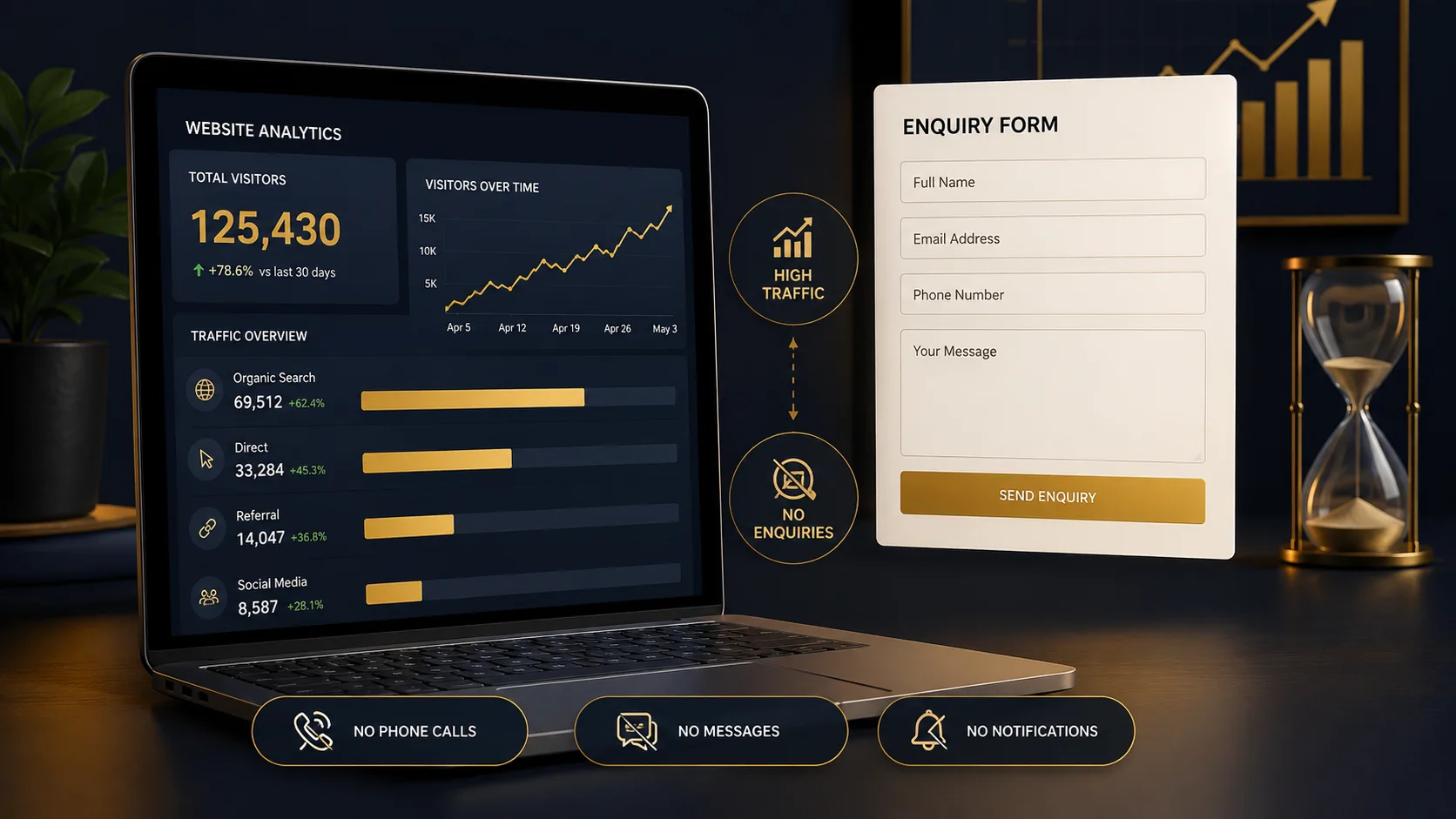
Analytics dashboard showing high website traffic beside an enquiry form with no messages
High visitor numbers can hide a serious problem if enquiries, calls and form submissions are low.

Your Website Does Not Build Enough Trust

Most visitors are cautious. They may like what you offer, but still need proof that you are credible. If there are no reviews, no examples of work, no case studies, no clear business details and no signs that real people are behind the website, they may not feel ready to get in touch.

Trust signals do not need to be overdone. In fact, they work best when they feel natural. Useful examples include:

  • Clear examples of previous work
  • Genuine testimonials or reviews
  • A proper About page
  • Visible contact details
  • Location information where relevant
  • Professional images and consistent branding

Your portfolio is especially important if someone is close to buying. People want to see whether you have done similar work before and whether the quality matches the price. Even a small number of strong examples can help turn a cautious visitor into a serious enquiry.


The Site Is Slow or Frustrating on Mobile

A website can have good content and still lose enquiries if it is slow, awkward or difficult to use on a phone. Many visitors will not wait around while large images, heavy scripts or unnecessary plugins load. They also will not fight with tiny buttons, cramped forms or menus that are hard to use.

Mobile usability is particularly important because many service searches happen when people are busy. They may be comparing options during a lunch break, on a train or while dealing with a problem that needs a quick solution. If your site makes that harder, they may choose a competitor simply because their website is easier to use.

Speed and mobile layout should be considered during the build, not treated as an afterthought. This is one reason a properly planned WordPress website can perform better than a heavily patched together template site.


Your Pages Do Not Match Search Intent

Sometimes the website attracts traffic from the wrong type of search. This can happen when pages are written around broad keywords but do not properly answer the visitor’s reason for searching.

For example, someone searching for website prices is likely comparing options and trying to understand budget. Sending them to a generic service page may not be enough. A guide such as how much a website costs in the UK is more likely to match their immediate question, then guide them toward the right service.

Likewise, someone searching for a local provider may need reassurance that the business understands their area. That is why separate local pages, such as web design in St Albans or SEO services in St Albans, can be useful when they are written properly and not duplicated across every location.


The Website Looks Fine, but the Journey Is Broken

Some websites look professional at first glance, but still fail to convert. The issue is not always visual quality. It is often the journey through the page.

A good service page should usually follow a clear structure:

  • Explain the service in plain language
  • Show who it is for
  • Explain the problem it solves
  • Show why the business is credible
  • Answer common objections
  • Make the next step obvious

If the page jumps between ideas, hides important information or sends people away before they understand the offer, enquiries will suffer. This is why small layout changes can sometimes make a big difference. Moving a call to action, rewriting a heading, improving a section order or adding proof in the right place can be more valuable than jumping straight into a full website redesign.

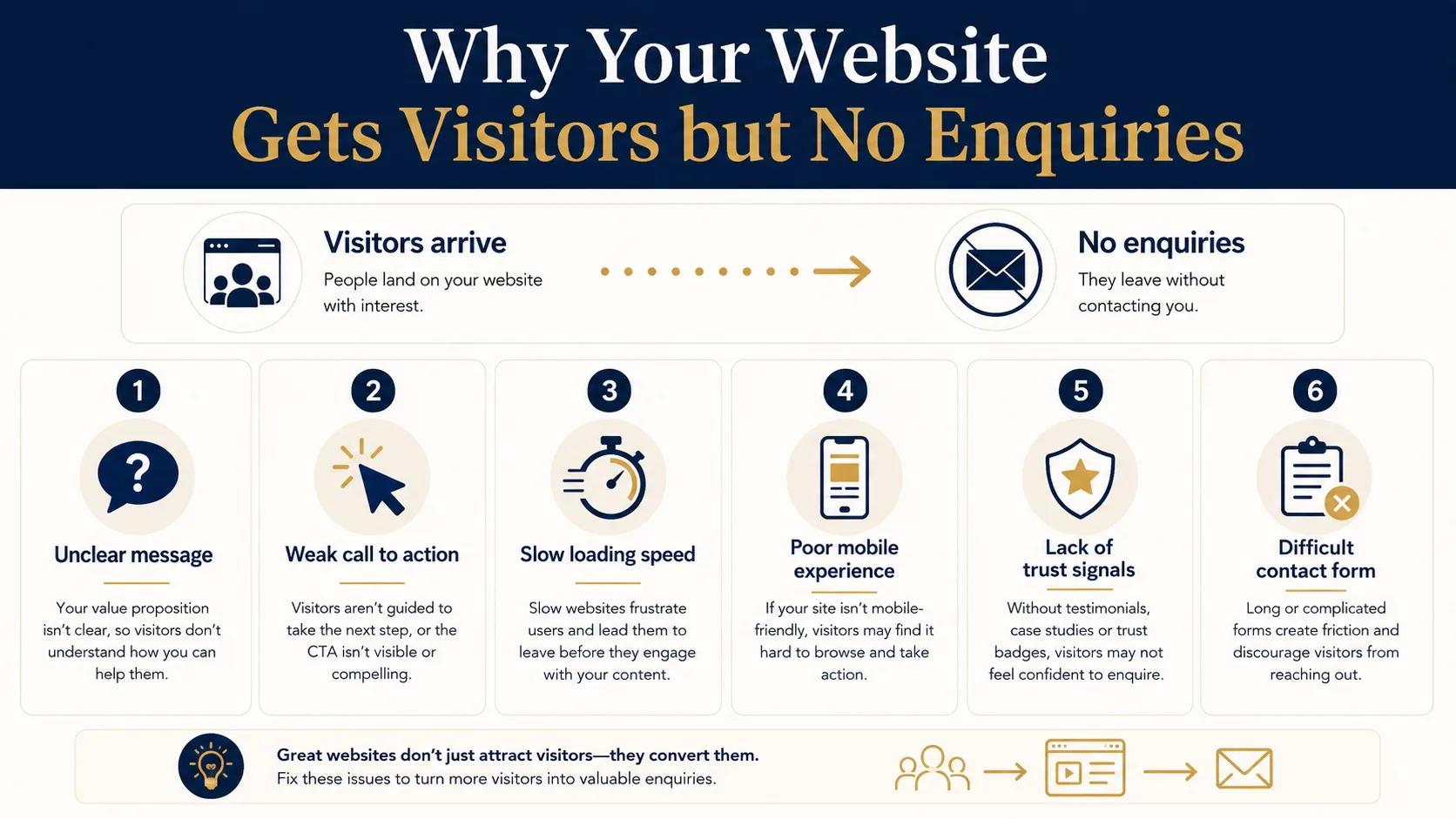
Infographic showing reasons website visitors do not become enquiries
Common conversion problems include unclear messaging, weak calls to action, slow speed, poor mobile experience, lack of trust and difficult forms.

How to Work Out What Is Going Wrong

You do not need to guess. Start by looking at the page as a new visitor would. Then check whether people are taking the actions you want them to take.

A practical review should include:

  • Checking which pages receive traffic
  • Testing the contact form and phone links
  • Reviewing the homepage and service page headlines
  • Checking speed and mobile layout
  • Looking for missing trust signals
  • Comparing your page against competitors
  • Checking whether the page has a clear next step

If you run paid traffic through Google Ads, this becomes even more important. Every click costs money, so a weak landing page can waste budget quickly. Paid advertising should not be used to cover up a poor website journey. The page needs to do its job once the visitor arrives.


What to Fix First

If your website gets visitors but no enquiries, do not start by changing everything. Work through the most likely problems in order.

1. Clarify the main message

Make sure the headline and first paragraph explain exactly what you do, who you help and why someone should keep reading.

2. Improve the main call to action

Use a clear button that matches the visitor’s intent. Put it near the top of the page and repeat it naturally where the page needs it.

3. Test the form and phone links

Make sure the basics work. A broken form can go unnoticed for weeks if nobody is checking.

4. Add proof

Show examples, reviews, case studies, accreditations or anything else that gives visitors confidence.

5. Improve speed and mobile usability

If the site is slow or awkward on mobile, fix that before spending more money on traffic.

Final Thoughts

Traffic is useful, but it is not the final goal. A business website should help the right people understand what you offer, trust you enough to make contact and take the next step without unnecessary friction.

If your website is getting visitors but not enquiries, the answer is usually not to chase more traffic straight away. First, make sure the pages receiving traffic are clear, trustworthy, fast, easy to use and built around a proper enquiry journey.

Need Help Turning Website Visitors Into Enquiries?

If your website gets traffic but does not bring in enough leads, Webtex can review the page structure, messaging, calls to action, speed and SEO foundations.

Ask Webtex to Review Your Website

TS
Tim Shortt

Senior Developer & Director, Webtex Digital Services. Over 13 years building WordPress websites and digital marketing solutions for businesses across Hertfordshire and the UK.

The Complete Business Start-Up Package: Everything You Need to Launch and Grow Online

Starting a business is hard enough without also having to become an expert in web design, SEO, Google Ads, branding, and hosting all at once. I’ve been working with start-ups and growing businesses in Hertfordshire for over 13 years, and the pattern I see repeated most often is this: people launch with whatever they can cobble together quickly, then spend the next two or three years trying to fix it. This article is about why that happens, what a proper digital foundation actually looks like, and how getting everything in place from the start saves a significant amount of time, money, and frustration.

The businesses that struggle most with their online presence aren’t the ones that did nothing — they’re the ones that did things cheaply and quickly, without thinking about how each piece connects to the next. A Wix site that can’t be migrated. A logo that only exists as a low-resolution JPEG. A Google Business Profile sitting unclaimed. None of these things feels catastrophic on its own, but together they create a digital presence that works against you rather than for you.

Getting the foundations right from the outset isn’t just neater — it’s genuinely cheaper in the long run.

What Does a Complete Digital Start-Up Package Include?

The scope of digital services a new business needs is broader than most people expect. Below is a breakdown of every component a serious start-up should have in place, and why each one carries weight. This joined-up approach is exactly what our complete business start-up package is designed to cover.

🌐
Website Design & Build
Custom WordPress development, built for speed, conversion, and search.
🔍
Search Engine Optimisation
On-page SEO, technical foundations, and local search from launch.
📢
Google Ads / PPC
Paid search campaigns that generate enquiries while organic rankings build.
🗺️
Google Business Profile
Full GBP setup and optimisation for local visibility and Maps presence.
🎨
Branding & Brand Assets
Logo, colour palette, typography, and brand guidelines.
🖨️
Marketing Materials
Business cards, leaflets, and print-ready artwork designed to match your brand.
🛡️
Hosting & Management
Managed hosting, security monitoring, backups, and ongoing maintenance.
⚙️
Development & Growth
Ongoing development as your business evolves — new features, pages, and integrations.

1. Your Website — The Foundation of Everything

Everything else — your SEO, your Google Ads, your social media presence — ultimately points back to your website. If it’s slow, hard to navigate, or doesn’t give people a reason to pick up the phone, you’re spending money to send people somewhere that won’t do anything with them. I’ve audited hundreds of small business sites over the years and the same issues come up constantly: enormous image files, generic template layouts, contact forms that don’t work, no SSL. The site is technically live, but it’s doing nothing.

At Webtex we build everything on WordPress, using custom hand-coded PHP page templates. We don’t use Elementor, Divi, or any other page builder — and that’s a deliberate decision, not a preference. Page builders generate bloated code that slows sites down, creates compatibility problems with updates, and locks you into a third-party platform you didn’t sign up for. A hand-coded site loads faster, ranks better, and is straightforward to maintain without specialist tools.

Why page speed matters at launch

Google uses Core Web Vitals as a direct ranking factor. A site that loads slowly on mobile — where the majority of local search traffic now comes from — will rank below a faster competitor regardless of how good its content is. We’ve seen this firsthand with clients who came to us after using page builders: rebuilding on a clean codebase typically moves their mobile PageSpeed score from the 40s into the 90s.

Starting with a fast site is considerably cheaper than rebuilding a slow one six months down the line.

2. SEO — Getting Found Without Paying for Every Click

SEO is the one area where I consistently see new business owners either ignore it entirely or wildly overestimate how quickly it works. The reality sits somewhere in the middle: organic search rankings take time — typically three to six months before meaningful traffic starts coming through on a new domain — but the work you do at launch has a direct impact on how quickly that happens and how high you end up ranking.

A site launched with proper on-page SEO, schema markup, correct canonical tags, and a sensible internal linking structure starts accumulating signals immediately. One launched without any of that has to go back and retrofit everything, often after the site has already been indexed with problems. Fixing things after the fact is slower and less effective than doing them right at the start.

For local businesses in Hertfordshire and beyond, the specific things that move the needle are:

  • Location-specific page structure targeting the towns and areas you serve
  • Schema markup communicating your business type, services, and location to search engines
  • Technical SEO covering site speed, mobile usability, crawlability, and indexing
  • A content strategy built around the search terms your customers actually use
  • Consistent NAP (Name, Address, Phone) data across all online platforms

The businesses ranking at the top of Google for competitive local searches got there because they invested in the right foundations early. That head start is hard to close once someone has it.

3. Google Ads — Revenue While You Wait for Organic Rankings

New domains don’t rank overnight. While your organic SEO is building, there’s a gap — sometimes three to six months — where you’re visible to almost nobody on Google. For a business that needs enquiries from week one, that gap is a real problem. Google Ads is the most direct way to bridge it.

A well-structured PPC campaign puts you in front of people who are actively searching for what you offer at the moment they’re looking. That’s a fundamentally different kind of audience from social media advertising, where you’re interrupting people who weren’t thinking about you at all. The catch is that Google Ads rewards expertise — poorly structured campaigns with broad match keywords and no negative keyword lists burn through budget fast and produce very little. I’ve taken over campaigns that were spending £800 a month and generating two or three leads. The same budget, restructured properly, produced fifteen.

Google Ads rewards expertise. I’ve taken over campaigns spending £800 a month and generating two or three leads. The same budget, restructured properly, produced fifteen. The difference isn’t the spend — it’s the setup.

We manage campaigns end to end — keyword research, campaign architecture, ad copy, bid strategy, landing page alignment, and ongoing optimisation. We report on cost per lead and cost per acquisition, not impressions or click-through rate. The only number that matters is what it costs you to get a customer.

4. Google Business Profile — Your Most Powerful Free Tool

If you serve customers in a specific area, your Google Business Profile is probably the highest-impact thing you can optimise — and it costs nothing to set up. A properly configured GBP listing puts you in the Maps results and the local pack at the top of Google search, often appearing above the organic results entirely. For a new business with no domain authority, that’s significant.

The problem is that most businesses treat GBP as a one-time setup job. They fill in the basic details, maybe add a few photos, and leave it. An optimised profile is a different thing altogether:

  • Accurate and consistent business name, address, and phone number
  • All relevant service categories selected correctly
  • A keyword-rich business description
  • Full service listings with descriptions
  • Regular photo updates
  • A structured approach to generating and responding to reviews
  • Google Posts used consistently to signal activity

Reviews in particular make a measurable difference to both rankings and click-through rates. We set up and fully optimise your GBP as part of the start-up package, including a review generation process you can actually sustain.

5. Branding — The Visual Language of Your Business

Branding gets treated as an afterthought by a lot of new businesses, and it shows. A logo knocked together on Canva, inconsistent colours across different platforms, a font that doesn’t work at small sizes — these things might seem minor but they communicate something specific to potential customers: that the business hasn’t invested in itself. People make fast judgements about whether to trust a business, and visual presentation is a significant part of that.

Good branding isn’t about having an expensive logo. It’s about having a coherent visual identity that works consistently across everything — your website, your business cards, your signage, your email signature, your van. When those things all look like they belong together, it builds recognition and, with recognition, trust.

We produce complete brand asset packages: primary and secondary logo variations, colour palette specifications, typography guidelines, and usage rules — everything needed by a printer, signage company, or anyone else who needs to represent your brand without you standing over their shoulder.

6. Marketing Materials — Taking Your Brand Offline

Plenty of business still gets done face to face — at trade events, networking meetings, on a doorstep after a quote. A business card or leaflet that looks professional and matches your website reinforces every other impression you’ve made. One that doesn’t — mismatched colours, a pixellated logo, the wrong phone number — undermines it.

We design print-ready business cards, A5 and A4 leaflets, and other marketing collateral that’s consistent with your brand and supplied in the correct format for any UK printer. If you’ve ever sent artwork to a printer and got something back that looked nothing like what you expected, it’s usually a file format or colour profile issue — we handle all of that.

7. Hosting, Management, and Maintenance — The Infrastructure Nobody Talks About

This is the part of the package most people don’t think about until something breaks. A WordPress site is a live piece of software — it needs updates, security patches, backups, and occasional attention. Left unmanaged, sites get hacked. It happens more often than people expect, and it’s not always obvious: one of the most common attacks we deal with is database injection that creates thousands of spam pages indexed by Google before the site owner has any idea. Cleaning that up properly takes days and costs considerably more than a year’s worth of maintenance fees would have.

Our managed hosting and maintenance service covers:

  • UK-based managed hosting with daily backups
  • WordPress core, theme, and plugin updates
  • Security monitoring and malware scanning
  • SSL certificate management
  • Performance monitoring and optimisation
  • Minor content updates and amendments
  • Technical support when you need it

It’s not a glamorous part of the package, but it’s the one that keeps everything else working.

Why One Agency Matters

The piecemeal approach is understandable — it feels like it keeps costs down and gives you flexibility. In practice it usually does neither. A logo from a freelancer on Fiverr, a website from a local agency, SEO from someone you found on Google, hosting from a provider nobody can remember setting up — this creates a situation where nobody has the full picture, nothing quite matches, and when something goes wrong there are three conversations to have before anyone does anything.

When one agency is responsible for the whole thing, the pieces fit together properly. Your brand is consistent across your website, your GBP, your ads, and your print materials because the same people designed all of them. Your SEO and your site architecture are aligned from the start because the same people built both. When your hosting needs attention, you call the same number you call for everything else. There’s no finger-pointing, no gaps in accountability, and no time spent briefing five different suppliers on the same background.

After 13 years of doing this, I can tell you that the businesses that get the best results are almost always the ones that treated their digital presence as a joined-up system rather than a collection of separate tasks farmed out to whoever was cheapest at the time.

Who is this package for?

We work with two types of client on this: businesses starting from scratch who need everything built from the ground up, and established businesses that have been trading for a while but have never had a digital presence worth the name. The challenges are slightly different but the approach is the same — understand the business properly, build everything to a standard that actually performs, and make sure it all works together.

If either of those descriptions fits, it’s worth having a conversation.

Getting Started

We start every project with a discovery call — no forms to fill in, no automated quotes. I want to understand your business, who your customers are, where you’re trying to get to, and what’s been tried before. From there I’ll put together a clear recommendation and a straightforward cost.

If you’re launching a new business or you’ve been running one without the digital foundations it deserves, get in touch. The conversation is free and there’s no obligation.

Let’s talk about your business

Based in St Albans, serving businesses across Hertfordshire and the UK. One call, no obligation — just a straight conversation about what you need and what it would cost.

Get in Touch

TS
Tim Shortt

Senior Developer & Director, Webtex Digital Services. Over 13 years building WordPress websites and digital marketing solutions for businesses across Hertfordshire and the UK.