Skip to content

How to Redesign Your Website Without Losing Rankings or Enquiries

A website redesign should improve the way your business is presented, make the site easier to use and give potential customers clearer reasons to contact you. It should not remove pages that already bring in traffic, break links that Google has been following for years or stop your enquiry forms from working.

The design itself is rarely the cause of a serious loss in search visibility. Problems usually appear because important content has been removed, URLs have changed without suitable redirects, internal links have broken or technical settings from the development site have been carried over to the live version.

A well-managed redesign starts by recording what already works. The new website can then improve the weaker parts without throwing away the rankings, links and enquiries the existing site has built up.

A Redesign and a Website Migration Are Not Always the Same Thing

The level of SEO risk depends on what is changing.

A visual redesign may keep the same domain, pages, URLs and content while changing the layout, colours and branding. This can still affect usability and page speed, but it is usually less disruptive than rebuilding the entire site.

A larger redesign may involve:

  • Moving to a different content management system
  • Rebuilding the website in WordPress
  • Changing the navigation and page structure
  • Rewriting or merging service pages
  • Replacing old URL addresses
  • Moving to a new hosting provider
  • Changing from HTTP to HTTPS
  • Moving to a different domain
  • Removing outdated products, services or locations

Once URLs, content or platforms change, the project also becomes a website migration. That needs more than design approval and a final visual check.

Google recommends preparing the new site, mapping old URLs to their replacements, implementing redirects and monitoring both versions after a move. Google also warns that some ranking fluctuation can occur while its systems recrawl and reprocess the changed pages.

A designer does not need to keep every part of the old website. The important point is to understand what each change may affect before making it.


Record What the Current Website Is Achieving

It is difficult to protect a website if nobody has recorded its current performance.

Before redesign work begins, create a baseline showing which pages receive traffic, appear in search results, attract links and generate enquiries. This should happen before content is rewritten or the old site becomes unavailable.

Useful information to record includes:

What to record Why it matters
Pages receiving organic clicks These pages may already rank for valuable searches
Pages receiving impressions A page may have visibility even if it currently gets few clicks
Queries associated with each page This helps preserve the subject and search intent
Enquiry and conversion pages Traffic has little value if the new site loses the enquiry route
Pages with external links Removing them may waste links earned from other websites
Popular landing pages Visitors may enter through pages other than the homepage
Existing URLs These are needed to create an accurate redirect map
Current titles and descriptions Useful wording can be retained or improved rather than lost
Forms, tracking and integrations These need to work after the redesign
Current rankings These provide context when monitoring the new site

Google Search Console can show queries, impressions, clicks, indexed pages and crawling problems. Analytics may provide additional information about landing pages, user behaviour and completed enquiries.

Do not rely only on a list of keywords supplied by an SEO tool. A page ranking at position two for an irrelevant phrase may be less valuable than a page at position eight that regularly generates suitable enquiries.

The redesign should protect commercial value, not just a collection of ranking positions.

Decide What Should Stay, Change, Merge or Go

Every existing page should have a planned outcome.

A practical content review usually places each URL into one of four groups:

  1. Keep: The page remains available at the same URL.
  2. Improve: The URL remains, but the content or layout is updated.
  3. Merge: Several overlapping pages are combined into one stronger page.
  4. Remove: The page no longer serves a useful purpose and has no suitable replacement.

Pages that already rank, receive links or generate enquiries should not be removed simply because they do not fit neatly into the new design.

A common redesign mistake is to replace detailed service pages with a shorter, more visual website. The new version may look cleaner, but Google and potential customers are left with less information.

For example, an existing service page might explain:

  • What the service includes
  • Who it is intended for
  • The problems it solves
  • How the process works
  • Relevant prices or timescales
  • Common customer questions
  • The areas the business covers
  • What someone should do next

Reducing that to a heading, a photograph and two short paragraphs may weaken the page considerably.

This does not mean every old sentence must remain. Outdated wording, repetition and weak content can be rewritten. The aim is to preserve the useful subject matter and intent while improving clarity.


Keep Important URLs Where It Makes Sense

The safest URL change is often no URL change at all.

If an existing page has a clear, readable address and still covers the same subject, keeping that address avoids an unnecessary redirect and makes the transition simpler.

Changing a URL because the new version looks slightly neater is not always worth the disruption. A page at:

/commercial-window-cleaning/

does not need to become:

/services/commercial-exterior-window-cleaning-solutions/

unless the new structure provides a genuine benefit.

There are valid reasons to change URLs. The old structure may be confusing, contain outdated service names or use addresses created automatically by an old system. Several weak pages may also need to be consolidated.

Where a URL changes, its old address should be matched to the most relevant new page.

Create the Redirect Map Before Launch

A redirect tells browsers and search engines that a page has moved.

For a permanent URL change, Google recommends using a permanent server-side redirect, normally a 301 or 308 response.

The redirect map should contain at least:

Old URL Planned outcome New URL Redirect required
Existing service page Retained Same URL No
Old service name Replaced New service page Yes
Two overlapping pages Merged Consolidated page Yes
Obsolete page Removed No equivalent No redirect
Old contact page Replaced New contact page Yes

Each old page should normally redirect to the closest relevant replacement.

Do not send every removed page to the homepage. Someone following a link to a specific service does not expect to arrive at a general homepage with no explanation. Google also warns that large numbers of irrelevant redirects may be treated as soft 404 errors.

Redirects should also lead directly to the final destination. Avoid arrangements such as:

Old page → temporary page → revised page → final page

These redirect chains make the journey slower and create more places for something to fail.

Google advises keeping site-move redirects in place for at least a year and, from a user perspective, potentially for longer. Internal links and important external profiles should still be updated to point directly to the new addresses.

Old website URLs mapped through 301 redirects to their relevant new pages
Map every changed URL to the closest relevant replacement before the redesigned website goes live.

Do Not Delete Pages Merely Because They Look Old

A page can look dated while still performing an important job.

Before removing one, check whether it:

  • Appears in Google Search Console
  • Receives visits from other websites
  • Ranks for a useful service or question
  • Supports another page through internal links
  • Generates contact-form submissions
  • Contains material that should be moved elsewhere
  • Is used as a Google Ads landing page
  • Appears in printed material, emails or social profiles

Some pages should be removed. An expired promotion, discontinued service or inaccurate article may have no continuing value.

Where no suitable replacement exists, returning a proper 404 or 410 response is often more accurate than sending visitors to an unrelated page.

Where several pages cover the same subject, they may be merged. The combined page must properly represent the material being removed, rather than mentioning it briefly to justify a redirect.


Protect the Meaning of Pages That Already Rank

Search performance is connected to what a page covers, not only its address.

A redesign can retain the exact same URL and still lose visibility if the content changes significantly.

Important elements to review include:

  • The main subject of the page
  • The service, product or question it addresses
  • The title shown in the browser and search results
  • The main heading
  • Supporting subheadings
  • Explanatory content
  • Internal links
  • Images and image descriptions
  • Structured data
  • Contact details and calls to action

Do not copy every heading simply because it existed before. Instead, understand why the page was relevant.

Suppose a page ranks for searches relating to emergency boiler repairs in a particular area. Replacing it with a general heating-services page may remove the specific information that made the original useful.

The redesigned page can be better written and better organised, but it should still answer the same need unless there is a deliberate reason to change direction.

Use a Private Development or Staging Website Carefully

Most redesigns are built on a staging website before they replace the live version.

The staging site should not compete with the existing website in search results. It may contain copied content, unfinished pages and test information that should not become public.

Password protection is usually the strongest way to keep a development website private. A noindex instruction can also tell supported search engines not to index accessible pages.

A robots.txt block is not the same as a noindex instruction. Google explains that robots.txt controls crawling and should not be relied upon to keep a web page out of search results. A blocked URL may still appear if Google discovers it through links elsewhere.

The opposite problem occurs at launch. A development site may have been protected correctly, but the noindex instruction is then left active when it becomes the live website.

This can remove the new pages from Google even though the website works normally for visitors.

Before launch, check:

  • Site-wide indexing settings
  • Page-level robots instructions
  • HTTP X-Robots-Tag headers
  • Robots.txt rules
  • Password protection
  • Canonical tags
  • Sitemap addresses

Do not assume that changing a WordPress visibility setting has corrected every other indexing instruction.


Carry the Main SEO Elements Across

A redesign should include a comparison between the old and new pages.

The new site needs its own carefully written metadata, headings and internal links, but valuable elements should not disappear unnoticed.

Page titles and descriptions

Retain the main relevance of successful page titles while improving any weak or outdated wording.

Meta descriptions are not guaranteed to be displayed exactly as written, but they can help describe the page clearly to potential visitors.

Heading structure

Each page should have one clear main heading, followed by useful subheadings that organise the content.

Changing the visual style of a heading should not accidentally turn every large line of text into an H1.

Canonical tags

Canonical tags should point to the correct live URL. A staging-domain canonical, an old HTTP address or an unrelated page can send conflicting signals.

Google advises using consistent canonical signals, including internal links and sitemap entries that point to the preferred version.

Internal links

Links within the new site should point directly to live, final URLs.

Do not leave internal links passing through old addresses simply because redirects are available. Redirects are a safety net for changed URLs, not a replacement for updating the website properly.

Internal links also help visitors discover related services and help search engines understand how pages are connected.

Structured data

Any useful structured data should be recreated accurately on the new site.

The details must match what visitors can see. Do not retain old business information, prices, reviews or service details merely because they were present in the previous code.

Images and media

Important images, PDFs and downloadable documents can receive traffic and external links of their own.

Move them carefully, update embedded addresses and redirect old file URLs where a suitable new version exists.

Protect Enquiries as Carefully as Rankings

A redesign can maintain its Google visibility and still perform worse commercially.

This happens when attention is given to rankings while the new enquiry journey receives only a quick visual check.

Test every way a potential customer can make contact:

  • Contact forms
  • Quote-request forms
  • Telephone links
  • Email links
  • Booking systems
  • Live chat
  • Checkout pages
  • Account registrations
  • Newsletter forms
  • File uploads
  • Payment confirmations

Submit each form and confirm that the message reaches the correct destination.

A form displaying a success message does not prove that the email was delivered. Check the receiving mailbox, spam protection, confirmation emails and any customer relationship management system connected to it.

Telephone links also need checking. The visible number may be correct while the underlying tel: link still calls an old number.

Other commercial details to verify include:

  • Business name
  • Address
  • Opening hours
  • Email addresses
  • Service areas
  • Pricing
  • Legal company information
  • Privacy notices
  • Cookie controls

These details may appear in page content, the footer, structured data, forms and reusable website templates. Correcting one visible instance does not necessarily correct all of them.

Website redesign testing for telephone calls, email delivery and enquiry form submissions
Rankings are only part of the job. Calls, emails, forms and other enquiry routes must also be tested.

Preserve Analytics and Conversion Tracking

A redesigned website should not create a gap in reporting.

Check that the correct analytics and conversion scripts are present on the live site. Depending on the business, these may include:

  • Google Analytics
  • Google Search Console verification
  • Google Ads conversion tracking
  • Telephone-call tracking
  • Form-submission events
  • Ecommerce tracking
  • Cookie-consent controls
  • Social advertising pixels
  • CRM integrations

Test whether events are being recorded rather than checking only whether the tracking code exists.

Thank-you pages and confirmation messages may change during a rebuild. If a conversion depends on a specific page address, the tracking setup may need to change with it.

Paid advertising also needs attention. Update campaign landing pages if their URLs have changed, and confirm that those pages still match the advert and keyword intent.

Google specifically recommends updating advertising campaigns, internal links and profile links after a site move.


Test the New Website Before It Replaces the Old One

Launch day should confirm a plan that has already been tested. It should not be the first time anyone checks the finished website.

A proper pre-launch review should cover several areas.

Content checks

  • All required pages are present
  • Important content has been transferred
  • Headings are clear and correctly ordered
  • Titles and descriptions are in place
  • Old placeholder content has been removed
  • Contact and business details are accurate
  • Images have suitable descriptions where needed
  • Policies and legal pages are current

Technical checks

  • Old and new URLs have been mapped
  • Redirect rules are prepared
  • Canonical tags use live addresses
  • The XML sitemap contains the intended pages
  • Indexable pages are not marked noindex
  • Robots.txt does not block important areas
  • Broken internal links have been corrected
  • Missing pages return the correct status
  • HTTPS works throughout the site
  • Mixed-content warnings have been removed

Usability checks

  • Navigation works on mobile and desktop
  • Buttons are large enough to use on a phone
  • Text remains readable at different screen sizes
  • Forms can be completed without layout problems
  • Pop-ups can be closed
  • Important information is not hidden on mobile
  • Keyboard navigation has been considered
  • Pages do not shift or jump excessively while loading

Commercial checks

  • Forms deliver messages
  • Phone links call the correct number
  • Email links use the correct address
  • Payments and bookings complete successfully
  • Analytics records visits
  • Conversion events are triggered correctly
  • Google Ads landing pages remain available
  • Confirmation messages contain accurate information

Resilience checks

  • A full backup exists
  • The old site can be restored if necessary
  • Hosting and DNS access are available
  • The person responsible for fixing launch problems is identified
  • Error logs can be reviewed
  • Caches can be cleared
  • The site has enough server capacity

The old website should remain available until the new version is ready. Replacing it with a temporary holding page for several weeks creates an unnecessary interruption for customers and search engines.

Pre-launch SEO checklist covering redirects, forms, tracking, canonicals, indexing and mobile testing
Complete the content, technical, usability and commercial checks before the new website replaces the old one.

Launch During a Quieter Period

There is no perfect time to launch a redesigned website, but avoid choosing the busiest sales period unless there is a strong reason.

A quieter period gives the developer time to check the live version and correct problems without affecting as many customers.

For many small business websites, a controlled launch will involve:

  1. Taking a final backup.
  2. Confirming the URL and redirect map.
  3. Moving the approved site to the live environment.
  4. Removing development indexing restrictions.
  5. Activating permanent redirects.
  6. Testing a representative sample of old URLs.
  7. Checking forms and contact details.
  8. Crawling the live site for errors.
  9. Submitting or checking the new sitemap.
  10. Reviewing Search Console and analytics.
  11. Clearing website, server and CDN caches.
  12. Testing the site on a device not used during development.

Where the domain changes, both the old and new properties should be verified in Search Console. Google also provides a Change of Address process for eligible domain moves.

A straightforward redesign using the same URLs and domain does not need to be treated like a domain migration. The launch process should match the actual changes being made.

Monitor the Website After Launch

The work is not finished when the homepage loads correctly.

Some problems only appear after search engines and real visitors begin moving through the site.

During the first days and weeks, monitor:

  • Organic clicks and impressions
  • Important page rankings
  • Page-indexing reports
  • Submitted and indexed sitemap URLs
  • 404 and server errors
  • Redirect behaviour
  • Form submissions
  • Telephone and email enquiries
  • Analytics events
  • Paid advertising conversions
  • Page speed and server response
  • Security and uptime alerts

Google says that a small or medium-sized website may take a few weeks for most moved pages to be processed, while larger sites can take longer. Temporary movement in search visibility is therefore possible, especially where URLs or domains have changed.

This does not mean every decline should be ignored.

A sudden loss affecting the whole website may indicate a site-wide problem, such as a noindex instruction, robots block, server failure or incorrect canonical setup.

A decline affecting one section may point to removed content, broken internal links, missing redirects or a changed page purpose.

Monitor individual pages and queries rather than relying entirely on the website’s overall average position. Google itself advises concentrating on impressions and clicks rather than treating an absolute average ranking as the sole measure of success.

Website performance dashboard used to monitor clicks, impressions, indexing and technical issues after launch
Monitor search performance, indexing, errors and enquiries after launch so problems are found quickly.

What to Check if Rankings Fall After a Redesign

Do not immediately start rewriting every page.

First, identify the scale and pattern of the change.

Check whether the page is still available

Open the old and new URLs. Confirm that the old page redirects to the intended replacement and that the new page returns a successful response.

Inspect the page in Search Console

The URL Inspection tool can show the current index status and whether Google can access the live page. It can also help identify canonical and indexing problems.

Compare the old and new content

Check whether useful sections, headings and internal links were removed.

The new page may technically exist but no longer answer the searches associated with its predecessor.

Review the canonical tag

Confirm that it points to the live version of the same page rather than the staging site, homepage or old domain.

Look for noindex instructions

Check page source, SEO-plugin settings and HTTP headers.

Test the redirects

Confirm that permanent redirects lead directly to relevant working pages.

Review the sitemap

The sitemap should list live canonical URLs, not old pages, redirects or staging addresses.

Check internal links

Important pages may have become difficult to find because the new navigation no longer links to them.

Check server performance

Repeated server errors or severe performance problems can interfere with crawling and frustrate visitors.

Review the date of the change

Compare the traffic decline with the actual launch date. Do not assume every movement around the same period was caused by the redesign.

Once the likely cause is understood, correct that problem and monitor the result. Repeated large-scale changes can make diagnosis harder.


Questions to Ask Before Hiring Someone for a Website Redesign

A business owner should not be expected to configure redirects or inspect canonical tags personally. The supplier should still be able to explain how these matters will be handled.

Before agreeing to a redesign, ask:

  • Will you review the current website before removing or changing pages?
  • Will you check which pages receive traffic and enquiries?
  • Are existing URLs being retained where possible?
  • Who will create and test the redirect map?
  • How will important content be transferred?
  • Will the development site be kept out of search results?
  • Will titles, headings, canonicals and structured data be reviewed?
  • Who will test forms, phone links and email delivery?
  • Will analytics and conversion tracking be checked?
  • What happens if something goes wrong at launch?
  • Will the site be monitored after it goes live?
  • Is SEO migration included in the quote or charged separately?
  • Who owns and controls the website, domain and hosting?
  • Will you receive access to the finished site?

Vague assurances that “SEO will be preserved” are not enough. The proposal should explain which migration and testing work is included.

A Redesign Should Improve More Than Appearance

Protecting existing visibility does not mean freezing the website in its current form.

A redesign is a chance to correct problems that have been limiting the business, including:

  • Confusing navigation
  • Weak service pages
  • Poor mobile layouts
  • Slow loading
  • Unclear calls to action
  • Difficult content editing
  • Unreliable forms
  • Outdated branding
  • Inconsistent contact details
  • Unnecessary plugins
  • Weak internal linking
  • Pages that compete with each other
  • Missing tracking

The right aim is not to reproduce the old website with a different colour scheme. It is to understand what should be preserved, fix what is holding the site back and launch the replacement without creating avoidable disruption.

Planning a Website Redesign?

Webtex Digital Services designs and builds WordPress websites for businesses that need a clearer structure, stronger enquiry routes and a reliable foundation for future SEO and marketing.

Before rebuilding an existing website, we can review the current pages, URLs, search visibility and technical setup so that useful content is not discarded by accident.

Tell us what is wrong with the current site, what you want the new version to achieve and whether you already receive traffic or enquiries through Google. We can then recommend the most sensible approach to the redesign.

TS
Tim Shortt

Senior Developer & Director, Webtex Digital Services. Over 13 years building WordPress websites and digital marketing solutions for businesses across Hertfordshire and the UK.

What to Check Before Paying for a New Website

Paying for a new website is a serious business decision. A good website can help you win enquiries, explain your services clearly and support your marketing for years. A poor one can leave you with a nice-looking page that is hard to update, difficult to rank, expensive to maintain and unclear for customers. Before you agree to a quote, there are a few things worth checking properly.

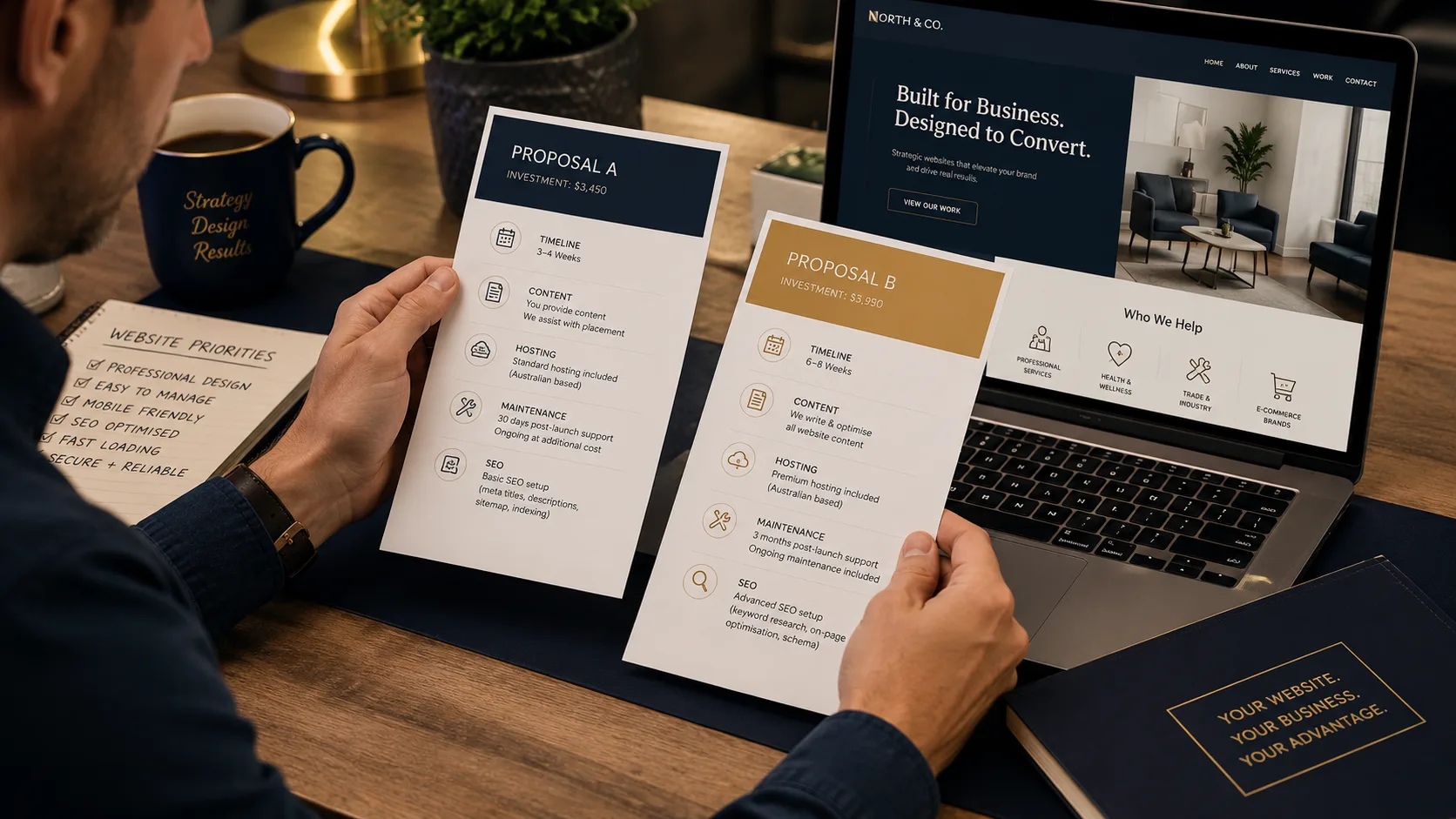
Website proposal, checklist and laptop showing a new website design before purchase
A new website should be treated as a business investment, not just a design purchase.

Start by Checking What the Website Is Meant to Do

Before comparing prices, make sure you know what the website is supposed to achieve. A brochure website, lead generation website, ecommerce store, booking website and membership platform all need different planning. The cheapest quote may only look cheap because it does not include the things your business actually needs.

For most service businesses, a website should help visitors understand who you are, what you offer, where you work, why they should trust you and what they should do next. If the proposal only talks about design and page count, it may not be thinking far enough ahead.

This is why professional web design starts with purpose. The layout, copy, images, calls to action and page structure should all support the reason the website exists. A site built only around appearance can look good on launch day but still fail to generate enquiries.


Ask for a Clear Scope Before You Pay

A proper website quote should explain exactly what is included. If the scope is vague, it becomes much easier for misunderstandings to appear later.

At minimum, you should know:

  • How many pages are included
  • Whether the design is bespoke or template-based
  • Whether copywriting is included
  • Who supplies images
  • Whether contact forms are included
  • Whether SEO basics are included
  • How many rounds of revisions are allowed
  • What happens after the website goes live

There is nothing wrong with a simple website package if that is what you need. The issue is not simplicity. The issue is paying for one thing while assuming you are getting another.

A good proposal should remove uncertainty. You should be able to read it and understand what will be built, what it will cost and what is expected from you.

Check Whether Content Is Included

Content is one of the most common causes of website delays. Many businesses accept a quote assuming the web designer will write the wording, only to find later that the client is expected to provide all of it.

Supplying your own content can work if you are comfortable writing clearly about your services. For many businesses, though, it is harder than expected. A website needs headings, service descriptions, calls to action, trust-building content and answers to the questions customers usually ask before buying.

If content is not included, ask what support is provided. Will the designer give you a page structure? Will they advise on what each page should say? Will they edit what you provide? Will they optimise the content for search engines?

This matters because content and structure affect SEO. A website can be visually polished but still struggle to rank if the pages are thin, vague or missing the terms your customers actually search for. If search visibility is important, ask whether SEO services are part of the project or whether they are quoted separately.


Confirm Who Owns the Website

Before paying for a website, check who owns the domain, hosting account, website files, content and design once the work is complete.

You should know whether:

  • The domain is registered in your name
  • You will have administrator access to the website
  • You can move the website to another host if needed
  • You own the written content and images supplied for the site
  • There are any licence restrictions on the design or plugins used

This is especially important when a website is sold on a monthly subscription. Some arrangements are perfectly fair, but you need to understand what happens if you stop paying. Do you keep the site? Can you export it? Do you lose access? Are there cancellation terms?

A good supplier should be clear about this. If ownership is difficult to understand before you pay, it is worth asking more questions.

Business owner reviewing a website design proposal, mockups and project notes
Review the scope, timeline, ownership, revisions and support before agreeing to a website project.

Check How the Website Will Be Built

Not all websites are built the same way. Two quotes can describe a “professional website” but involve very different levels of work.

Some websites are built using pre-made templates with limited customisation. Others are custom designed and developed around the business. Some rely heavily on page builders and third-party plugins. Others use cleaner code and more controlled development. None of these options are automatically wrong, but they are not the same product.

If you are paying for a serious business website, ask how it will be built and why that approach is suitable. A custom WordPress development project should give you a site that is easier to manage, better structured and more suitable for long-term growth than a rushed template setup.

You do not need to understand every technical detail. You do need to understand whether the website is being built for your business or simply assembled from whatever is quickest.


Make Sure Mobile and Speed Are Included

A modern website must work properly on mobile. That should not be an optional extra. Many visitors will view your site on a phone first, especially if they are searching for a local service, comparing providers or looking for a quick way to contact you.

Ask whether the site will be tested on different screen sizes. Check whether forms, menus, buttons and images will be properly optimised for mobile users.

Speed also matters. Slow websites frustrate visitors and can reduce enquiries. They can also make SEO harder. Large image files, unnecessary scripts, bloated page builders and too many plugins can all affect performance.

If performance is important to you, ask the supplier how they approach page speed, image optimisation and Core Web Vitals. If the answer is vague, that is worth noting.


Ask What SEO Means in the Quote

Many website quotes mention SEO, but the word can mean very different things. Sometimes it means the site will have basic title tags and descriptions. Sometimes it includes proper keyword research, service page planning, internal linking, technical SEO, local SEO and content structure.

Before you pay, ask what is actually included. A sensible SEO foundation should usually cover:

  • Page titles and meta descriptions
  • Clear heading structure
  • Search-friendly URLs
  • Image alt text
  • Fast, mobile-friendly pages
  • Internal links between relevant pages
  • Submission to Google Search Console
  • Basic schema where appropriate

If you are targeting local customers, you may also need location pages, Google Business Profile optimisation and content that matches local search intent. For example, a business targeting Hertfordshire may benefit from a properly written local page such as web design in St Albans or SEO services in St Albans, rather than trying to make every location fit onto one generic page.

Understand the Revision Process

Most website projects involve some changes. That is normal. The important thing is knowing how revisions are handled before the project begins.

Ask how many review stages are included, how feedback should be provided and what counts as a revision. A small wording change is different from changing the entire structure of a page after it has been built.

A clear revision process protects both sides. You know when you can give feedback, and the designer can keep the project moving without endless changes that were never part of the original scope.

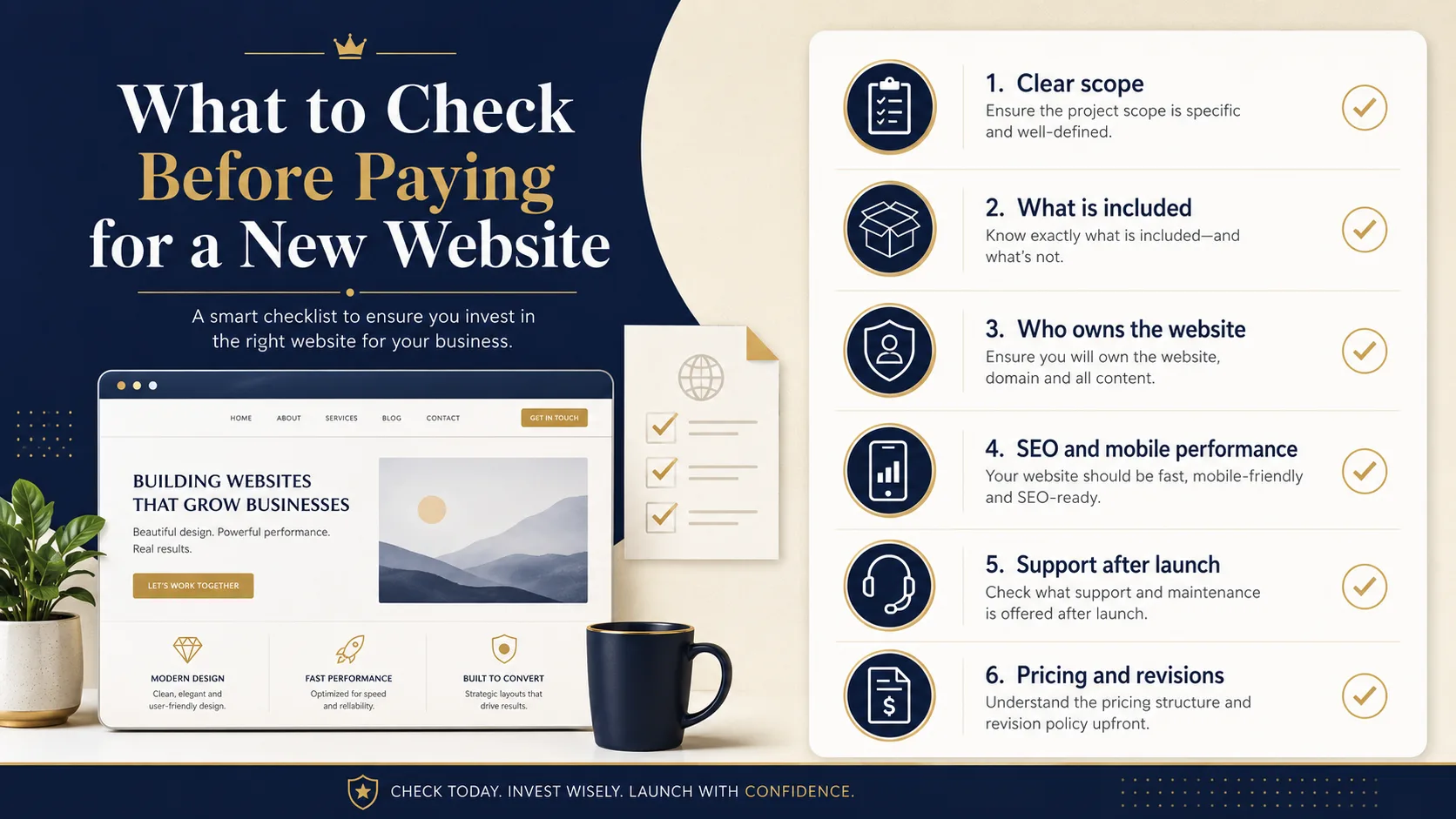
Infographic showing what to check before paying for a new website
A useful website checklist should cover scope, inclusions, ownership, SEO, performance, support, pricing and revisions.

Check What Happens After Launch

A website does not stop needing attention once it goes live. WordPress updates, plugin updates, backups, security checks, performance monitoring and small content changes all need handling.

Ask whether any post-launch support is included. For example, do you get a handover? Is training provided? Are bugs fixed for a short period after launch? What happens if a form stops working, a plugin update causes a problem or you need a small change?

Many businesses do not want to manage the technical side themselves. In that case, a website maintenance plan may be worth arranging from the start. It is usually easier to prevent problems than to fix them after something has broken.


Compare Value, Not Just Price

It is sensible to compare prices, but price alone does not tell you much unless the quotes include the same things. One quote might include planning, design, development, SEO setup, copywriting guidance, testing, launch support and maintenance advice. Another might include only a basic page build.

When comparing website quotes, look at what each one gives you in practical terms:

  • Will the site help customers understand your services?
  • Will it be easy to update?
  • Will it be fast and mobile-friendly?
  • Will it be structured properly for search?
  • Will it make enquiries easier?
  • Will there be support after launch?

If you are unsure what a fair price looks like, our guide to how much a website costs in the UK explains the main factors that affect website pricing.

Look at Previous Work

Before choosing a supplier, look at examples of previous projects. A portfolio will not tell you everything, but it gives you a sense of the design quality, range of work and level of detail.

When reviewing a website portfolio, do not only look at whether the screenshots are attractive. Ask whether the sites appear clear, easy to use and suitable for the type of business they represent. A good website should feel appropriate for the client, not just impressive in isolation.


Make Sure the Website Is Built Around Enquiries

If you are a service business, your website should make it easy for visitors to enquire. That means clear calls to action, visible contact routes, sensible page structure and enough trust signals to help people feel comfortable getting in touch.

This is one of the most important checks before you pay. A site can look modern and still fail if visitors do not know what to do next. If your current site already gets traffic but does not generate leads, read our guide on why websites get visitors but no enquiries.

If you are starting a new business and need more than a standalone website, it may also be worth considering a wider package covering branding, web design, SEO foundations and marketing setup. Our complete business start-up package is designed for that type of project.

Final Thoughts

Before paying for a new website, take time to understand exactly what you are buying. A good website project should have a clear scope, sensible structure, proper ownership terms, mobile and SEO considerations, realistic pricing and support after launch.

If you are still comparing options, our main web design services page explains how Webtex plans and builds professional business websites around clarity, trust and enquiries.

The right website supplier will not rush you into a decision. They will explain what is included, point out anything that may affect the project and help you choose the option that makes sense for your business.

Planning a New Website?

Webtex can help you understand what you need, what should be included and what level of website is right for your business.

Ask Webtex About Your Website

TS
Tim Shortt

Senior Developer & Director, Webtex Digital Services. Over 13 years building WordPress websites and digital marketing solutions for businesses across Hertfordshire and the UK.

Using AI in Website Design: How to use AI properly in Web Design

Artificial intelligence is rapidly changing the way websites are planned, designed, written and built. For business owners, AI can make the web design process faster, more efficient and more affordable. For designers and developers, it can speed up research, content creation, coding, testing and optimisation.

However, AI is not a replacement for professional web design. Used badly, it can create generic content, poor layouts, inaccurate information and websites that look unfinished or lack personality. Used properly, it can be a powerful tool that supports creativity, improves productivity and helps create better websites.

The key is understanding where AI is useful, where human expertise is still essential, and how to combine the two effectively. This is especially important when planning a professional business website, where design, content, performance and SEO strategy all need to work together.

Website designer using AI tools to plan a professional website layout and user experience
AI can support the web design process, but it works best when guided by human creativity and strategy.

What AI Can Do in Website Design

AI can assist with many parts of the web design process. It can help generate ideas, plan page structures, write draft content, suggest layouts, create images, improve code and identify potential SEO opportunities.

For example, AI can be used to brainstorm website ideas, create first drafts of website copy, suggest headings and calls to action, generate image concepts, help write HTML, CSS, JavaScript or PHP, improve existing content, create meta titles and descriptions, analyse competitors and plan blog articles.

This can save a huge amount of time, especially during the early stages of a project. Instead of starting with a blank page, AI can provide a strong starting point that can then be refined by a professional designer or business owner. For businesses planning a new site, this works best alongside proper WordPress development, clear messaging and a strong conversion strategy.

Why AI Should Not Replace Human Web Design

Although AI is useful, it should not be relied on to build an entire website without human input. A successful website needs more than text, images and code. It needs strategy, branding, user experience, trust signals, conversion planning, technical performance and search engine optimisation.

AI does not fully understand your business, your customers, your tone of voice, your local market or your long-term goals unless it is carefully guided. It may also produce content that sounds good but is vague, repetitive or inaccurate.

A professional web designer brings judgement. They know what should be included, what should be removed, how a page should flow, what will help users take action, and how to make the website feel credible and trustworthy.

AI can assist with the work, but it should not be allowed to make all the decisions. If you are looking for a more strategic approach, our web design in St Albans service is built around creating websites that look professional and support real business goals.

Use AI for Ideas, Not Final Decisions

One of the best ways to use AI in website design is for idea generation. It can help you explore different approaches quickly.

For example, you could ask AI to suggest homepage section ideas for a local service business, different headline options for a landing page, FAQ questions customers may ask, blog topics based on your services, or ways to explain a complex service more simply.

This is extremely useful, but the results should be reviewed carefully. Not every suggestion will be suitable. Some may be too generic, too sales-focused or not relevant to your audience.

The best approach is to use AI as a creative assistant, then apply human judgement to choose the strongest ideas.

Use AI to Draft Website Content

AI can be very helpful when writing website content, especially when creating a first draft. Many business owners struggle to describe their services clearly, and AI can help structure the information in a more professional way.

However, AI-generated content should always be edited. It often needs to be made more specific, more personal and more accurate.

Good website content should include what the business actually does, who the service is for, the areas covered, the benefits to the customer, the process involved, why the business can be trusted and clear calls to action.

AI may create a decent draft, but it is the human input that makes the content believable and useful. This is also where SEO matters, because content should be written for users while still supporting the search terms your business wants to be found for.

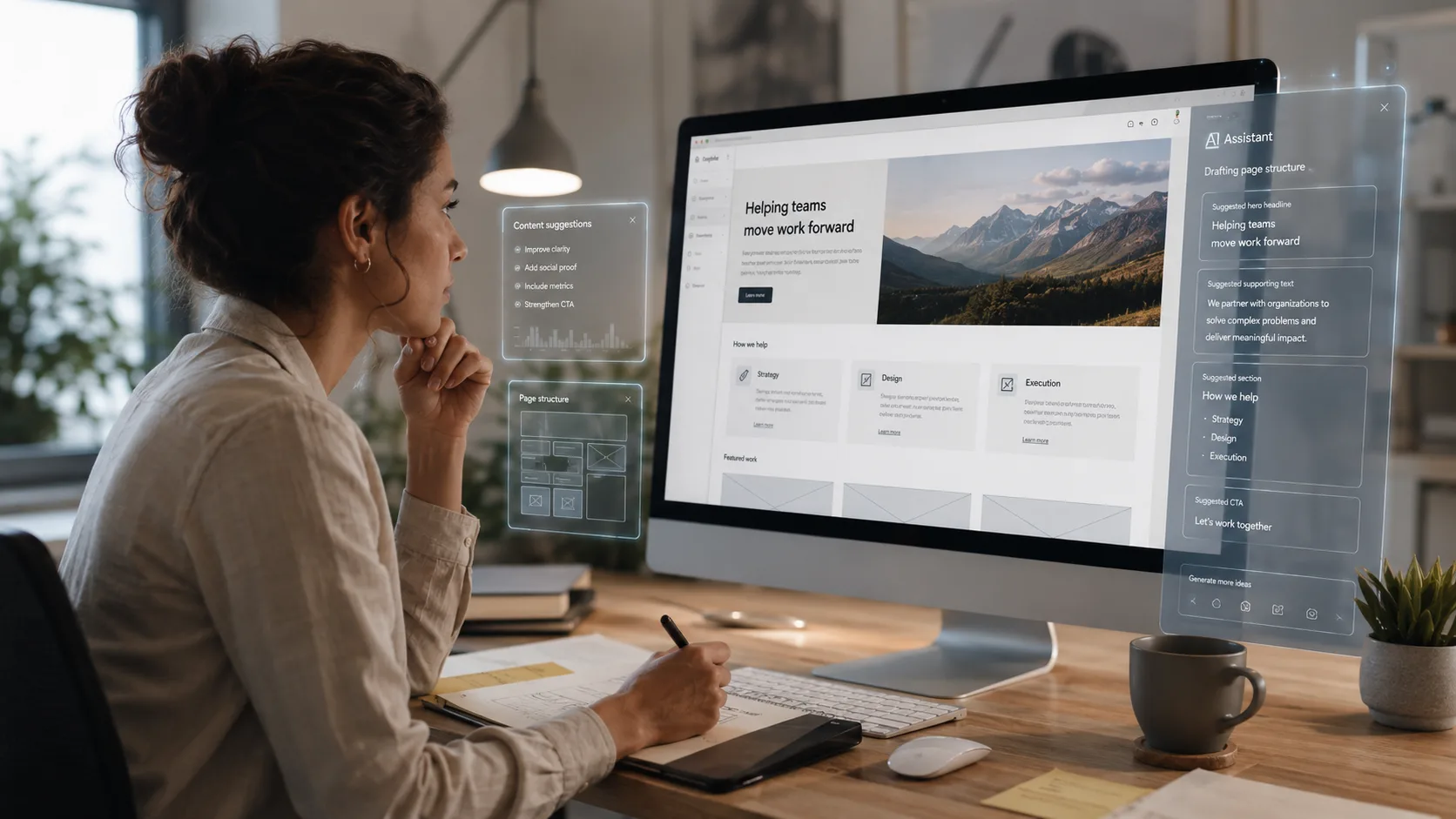
Designer reviewing AI-generated website content ideas and page structure on a large monitor
AI can help create first drafts and structure ideas, but the content still needs to be checked, edited and personalised.

Avoid Generic AI Content

One of the biggest risks of using AI in web design is ending up with generic content. Many AI-written websites sound very similar. They use phrases such as “tailored solutions”, “high-quality service”, “take your business to the next level” and “we are passionate about helping our clients succeed”.

These phrases are not necessarily wrong, but they are overused. They do not tell the visitor anything specific about the business.

To use AI properly, you should give it detailed information. Instead of asking it to “write a homepage for a web design company”, provide details about the services, location, target customers, pricing style, tone of voice and what makes the business different.

The better the input, the better the output.

Use AI to Improve User Experience

AI can help identify ways to make a website easier to use. You can ask it to review a page structure and suggest improvements to the user journey.

For example, AI can help answer questions such as whether the page is easy to understand, whether the call to action is clear, whether there are too many sections, whether important information is missing, whether the content could be simplified, and whether the headings are in a logical order.

This can be useful when planning landing pages, service pages and homepage layouts. However, the final user experience still needs to be tested by real people. AI can make suggestions, but actual visitors decide whether a website is clear and convincing. Reviewing examples of completed projects, such as those in a website design portfolio, can also help identify what works well in real business websites.

Use AI Carefully for SEO

AI can be useful for search engine optimisation, but it needs to be used carefully. It can help create keyword ideas, draft meta titles, write FAQs and suggest page structures. It can also help identify content opportunities for local SEO.

For example, a web design business may use AI to plan separate service pages for different locations, create article ideas around website costs, or draft FAQs about web design, hosting and maintenance.

However, AI should not be used to mass-produce low-quality SEO pages. Search engines are becoming better at recognising unhelpful content. Pages should be written for real users first, with SEO built in naturally.

Proper SEO content should be useful, specific and relevant. It should answer real questions and provide genuine value. For local businesses, this is especially important when targeting competitive searches such as SEO services in St Albans.

Use AI for Coding Support

AI can be very helpful for coding tasks. It can explain errors, suggest improvements, create snippets and help with HTML, CSS, JavaScript, PHP and WordPress development.

This can speed up development, especially for repetitive or technical tasks. For example, AI can help create custom CSS, fix layout issues, write schema markup, build simple functions or troubleshoot WordPress templates.

However, AI-generated code should always be checked. Code can contain mistakes, security issues or compatibility problems. It may also solve one issue while creating another.

For professional websites, code should be tested properly before being added to a live site. Once a site is live, regular website maintenance also helps keep it secure, updated and performing properly.

Web developer using AI to improve website code, SEO and performance optimisation
AI can help with code, SEO and optimisation, but everything should be reviewed and tested before going live.

Use AI for Image Concepts, But Keep Branding Consistent

AI image generation can be useful for creating visual ideas, hero images, blog graphics and design concepts. It can help when stock photos feel too generic or when a business needs a specific type of image that is difficult to find.

However, AI images should be used with care. Some may look unrealistic, include strange details or feel inconsistent with the rest of the website. They also need to match the brand style, colours and tone of the site.

Before using AI images on a website, check that they are high quality, relevant to the page, consistent with the brand, not misleading, properly optimised for web performance and given appropriate alt text.

Images should support the content, not distract from it.

Keep the Human Touch

The most effective websites feel clear, trustworthy and personal. They show that there is a real business behind the screen. This is where human input matters most.

AI can help write content, but it cannot replace real experience, customer understanding or brand personality. A website should include genuine information about the business, real services, real locations, real examples and clear reasons why someone should make an enquiry.

Customers are more likely to trust a website that feels authentic. If the whole site feels like it was generated automatically, it may fail to build confidence.

Check Everything AI Produces

AI can make mistakes. It can invent facts, misunderstand instructions or produce content that sounds confident but is inaccurate.

Before publishing AI-assisted content, always check facts and claims, spelling and grammar, tone of voice, service details, contact information, location information, legal or industry-specific claims, SEO metadata, image accuracy and code quality.

AI should speed up the process, not remove the need for quality control.

The Best Way to Use AI in Web Design

The best approach is to use AI as part of a professional workflow.

A sensible process would be to plan the website strategy manually, use AI to generate ideas and draft content, edit the content so it matches the business, design the layout around the user journey, use AI to support coding and optimisation, test everything manually and refine the website based on real feedback.

This approach gives you the speed of AI without losing the quality, personality and judgement that a good website needs.

Conclusion

AI is a powerful tool in modern website design, but it works best when used properly. It can help with ideas, content, SEO, coding, image concepts and website planning. It can save time and improve efficiency, especially when guided by someone who understands web design.

However, AI should not replace human creativity, strategy or attention to detail. A successful website still needs clear messaging, strong branding, good user experience, technical quality and a genuine understanding of the customer.

The best websites will not be created by AI alone. They will be created by people who know how to use AI intelligently as part of a wider web design process. If you would like help planning a professional website, explore our digital services or request a quote through the site.

How Much Does a Website Cost in the UK? (Realistic Prices Explained)

One of the most common questions we hear from business owners is: “How much does a website actually cost?” It’s a fair question — and one that’s surprisingly difficult to answer without context. Website pricing in the UK varies widely, and understanding why prices differ is far more useful than chasing the cheapest quote. If you are comparing options for a business site, our web design services page also explains how we approach bespoke builds. This guide explains realistic website costs, what affects pricing, and what most small businesses should budget for if they want a website that does more than simply exist online.


Typical Website Costs in the UK

Visual comparison of UK small business website price tiers from budget to bespoke with typical price ranges
UK website pricing tiers — from entry-level template builds to fully bespoke growth-focused sites

Most small business websites fall into one of the following ranges.

£300 – £800: Template or DIY Websites

At this level, websites are usually built using:

  • Pre-made themes
  • Drag-and-drop builders
  • Minimal customisation

These sites can work for:

  • New startups testing an idea
  • Side projects
  • Businesses that only need basic information online

However, they often struggle when a business starts to grow. Common issues include limited flexibility, weak search visibility, and layouts that don’t guide visitors toward making contact.

Many businesses we speak to locally end up replacing these sites sooner than expected.


£1,500 – £3,000: Professional Small Business Websites

This is where most established UK small businesses find the best balance of value and longevity.

A website in this range typically includes:

For businesses in areas like Hertfordshire, where competition is often local but consistent, this level of website is usually enough to support enquiries, build trust, and adapt as the business evolves.


£3,000 – £6,000+: Growth-Focused Websites

At the higher end, a website becomes a business asset, not just a marketing tool.

These projects often include:

  • Fully bespoke design
  • Conversion-focused layouts
  • Advanced SEO structure
  • Speed and performance optimisation
  • Integrations such as booking systems or CRMs

This type of site is common for service businesses in competitive markets, where online visibility plays a direct role in revenue.


What Actually Affects Website Cost?

Two websites with the same number of pages can have very different price tags. The difference usually comes down to the following factors.

Web designer creating a custom website layout on a computer screen in a modern workspace
Custom web design involves far more planning and expertise than adapting a pre-made theme

Design vs Templates

Custom design takes more time and expertise than adapting an existing theme. The benefit is a site that reflects your brand properly and avoids the “off-the-shelf” look many template sites share.

Templates can reduce upfront cost, but they often introduce compromises later.


Content and Structure

Effective websites are planned, not filled.

Time is spent on:

  • Structuring pages logically
  • Writing content that’s easy to scan
  • Guiding visitors toward taking action

When this stage is rushed, websites may look fine visually but fail to convert visitors into enquiries.


SEO Foundations

SEO isn’t something bolted on after launch.

Proper setup includes:

  • Clean URLs
  • Page titles and meta descriptions
  • Logical internal linking
  • Mobile usability
  • Fast loading pages

Websites built without this foundation often require fixes later, which can cost more than doing it properly from the start.


Features and Functionality

Additional features increase complexity and cost, for example:

  • Booking systems
  • Ecommerce
  • Membership areas
  • Custom forms
  • Third-party integrations

Each feature adds development time and testing, which affects pricing.


Ongoing Website Costs to Be Aware Of

A website is not a one-off purchase. Typical ongoing costs include:

  • Hosting: £10–£40 per month, depending on quality
  • Maintenance: updates, backups, and security through a reliable website maintenance plan
  • Content updates: occasional changes or new pages
  • SEO or marketing: if growth is a goal

Cutting corners on hosting or maintenance often leads to slow performance, security issues, or downtime.


Why Cheap Websites Often Cost More Over Time

Many businesses end up paying twice for their website.

This usually happens because:

  • The site can’t be expanded
  • SEO was not considered
  • Performance issues affect enquiries
  • The design no longer reflects the business

A website built properly tends to last longer, require fewer fixes, and support growth rather than holding it back.

Business owner frustrated while rebuilding a cheap website that no longer meets business needs
Many businesses end up paying twice — once for a cheap build and again when it fails to deliver

Choosing the Right Budget for Your Business

When deciding what to spend, it helps to ask:

  • Will this website be responsible for generating enquiries?
  • How competitive is my local market?
  • Will I need to add services or features later?

If your website plays an active role in winning work, it’s usually better treated as an investment rather than a cost. For new businesses that need the website, branding, SEO and hosting planned together, a complete business start-up package can be a more joined-up option than buying each element separately.


Frequently Asked Questions

Is it worth paying more for a custom website?

In many cases, yes. Custom websites are easier to adapt over time and tend to perform better when it comes to usability and search visibility.

Can I start small and upgrade later?

Yes — but only if the site is built on a flexible platform like WordPress. Many low-cost builds make upgrades difficult or impossible.

How long should a business website last?

A well-built website should last several years, with regular updates and occasional improvements rather than full rebuilds.


Final Thoughts

Website costs in the UK vary because business needs vary.

The key is understanding what you’re paying for and whether the website will still support your business a few years down the line. A good website should make your business easier to find, easier to trust, and easier to contact. If you are comparing options and want to understand what is involved in a professional build, our web design services page explains how Webtex plans and builds business websites.

TS
Tim Shortt

Senior Developer & Director, Webtex Digital Services. Over 13 years building WordPress websites and digital marketing solutions for businesses across Hertfordshire and the UK.

Why People Leave Your Website (And What To Do About It)

You’ve built a website, maybe spent real money on it, and people are landing on it. But they’re leaving almost immediately. Sound familiar? Before you blame Google, your industry, or the economy — the answer is almost always on the page itself. Here’s what’s actually driving visitors away and, more usefully, what you can do about it.

The average website has a bounce rate somewhere between 40% and 60%. That means roughly half of everyone who visits leaves without doing anything. Some of that is unavoidable — but a lot of it isn’t.

1. Your Page Takes Too Long to Load

Speed is probably the single biggest reason people leave, and it’s also the most fixable. Google’s own data shows that as page load time goes from one second to three seconds, the probability of someone bouncing increases by 32%. By ten seconds, that figure is even more alarming.

The frustrating thing is that most slow websites don’t feel slow to their owners — you’re used to it, and your browser has probably cached half the assets anyway. Your visitors are experiencing it fresh, often on a mobile connection.

What to do: Run your site through Google PageSpeed Insights (it’s free) and pay attention to the Core Web Vitals scores. The most common culprits are oversized images, too many plugins doing things in the background, cheap hosting, and fonts loading from external servers. Fix the images first — that’s usually where the biggest gains are.

Google PageSpeed Insights screenshot comparing good and poor performance scores with Core Web Vitals metrics

2. It Doesn’t Work Properly on Mobile

More than half of web traffic is now on mobile devices. If your site is hard to use on a phone — tiny text, buttons that are impossible to tap, content that overflows the screen — people will leave immediately and probably not come back.

This isn’t just about making things smaller. A genuinely mobile-friendly site thinks about how people actually use phones: thumbs rather than mouse pointers, portrait orientation, variable screen sizes, and the fact that people are often doing something else at the same time.

What to do: Use your actual phone to browse your own site as if you’d never seen it before. Can you read the text without zooming? Can you tap the navigation without accidentally hitting the wrong link? Can you fill in your contact form without it being a nightmare? If the answer to any of these is no, you have work to do.

3. Nobody Knows What You Actually Do

This one is more common than you’d think. You land on a site and within five seconds you can’t figure out what the business does, who it’s for, or why you should care. Maybe there’s a clever tagline that says something like “Empowering tomorrow’s connections today.” What does that mean? Nothing, to most people.

Visitors make very quick decisions. If they can’t immediately understand what you offer and whether it’s relevant to them, they’ll go back to Google and try the next result.

What to do: Ask someone who doesn’t know your business to look at your homepage for five seconds, then close it and tell you what you do. If they can’t, your messaging isn’t clear enough. Your homepage headline should answer three things: what you do, who for, and roughly what they get. Simple, specific, and honest beats clever every time.

4. The Design Looks Outdated or Untrustworthy

People judge websites the same way they judge shops or offices. If it looks neglected, cheap, or like it was built in 2009, it creates doubt about whether the business behind it is credible. That’s not fair, but it’s human nature.

This doesn’t mean you need a flashy, expensive-looking site. It means the design needs to look deliberate and cared for. If the site no longer reflects the standard of the business, it may be time to look at a more professional web design approach. Inconsistent fonts, clashing colours, blurry images, and layouts that don’t quite line up all signal that someone didn’t pay much attention.

What to do: Look at your site on a decent monitor and be honest with yourself. Compare it to competitors you respect. If there’s a significant gap, it’s probably affecting your conversions more than you realise. A clean, simple, well-thought-out design will always outperform a flashy but cluttered one.

Side-by-side comparison of a cluttered website design and a clean modern website layout

5. There’s No Clear Next Step

People don’t want to have to figure out what to do on your website. If they’ve read something interesting and there’s no obvious way to get in touch, find out more, or take the next step, they’ll leave. Every page should have a purpose, and that purpose should be obvious.

The common mistake is having too many calls to action all competing for attention, or burying the most important one at the bottom where nobody scrolls to. The other common mistake is having none at all and just hoping people will find the contact page.

What to do: For each page on your site, ask yourself: what do I want someone to do after reading this? Make that one thing prominent, clear, and easy. “Get a free quote,” “Book a call,” “See our work” — specific is better than generic. “Contact us” is the weakest possible call to action.

A good call to action tells people exactly what happens when they click it, removes uncertainty, and makes the next step feel low-risk. “Book a free 20-minute call” is far more effective than “Get in touch.”

6. The Content Isn’t Actually Helpful

A lot of website copy was written by someone who knows the business well, which means it’s often full of jargon, too focused on the company rather than the customer, and doesn’t really answer the questions people are actually asking.

People come to your website with questions and problems. If your content doesn’t address those — if it’s mostly about how great your company is and how many years you’ve been trading — they’ll look elsewhere for the information they need.

What to do: Think about the questions your customers ask you before they decide to work with you. Answer those questions clearly on your website. Service pages should explain outcomes, not just list what you do. About pages should explain what makes you the right choice, not just recount company history.

7. There’s Too Much Going On

Popups, chat widgets, cookie banners, newsletter signup boxes, autoplay videos, moving elements — websites have a habit of accumulating these things over time. Each one felt like a good idea when someone added it. Together, they create noise that makes it harder for people to focus on the reason they came to the site.

When everything is trying to grab attention, nothing gets it. People hit the back button because the cognitive load is just too high.

What to do: Do an honest audit of everything that appears on your site uninvited. Ask whether each element is genuinely serving your visitors or just serving an internal goal. Often the most effective thing you can do is remove things, not add them.

8. There’s No Proof It Works

People buying services online can’t shake your hand or get a feel for you the way they would in person. They need other signals to decide whether to trust you. If your site has no reviews, no testimonials, no case studies, and no visible evidence that other people have used you and been happy — that’s a real problem.

Potential customers are looking for reasons to trust you. If those signals aren’t there, doubt fills the gap.

What to do: Get some reviews on Google and display them on your website. Even three or four genuine testimonials from happy clients make a meaningful difference. If you’ve done work you’re proud of, show it. Case studies that explain the problem, what you did, and the outcome are particularly powerful.

Example website layout showing customer testimonials and trust signals including review ratings and credibility badges

The Honest Answer

Most of these issues come down to the same underlying problem: the website was built without enough thought about the person on the other end of it. It was built to look good in a portfolio, to tick a box, or to satisfy a brief — rather than to genuinely serve the people it was supposed to attract.

The good news is that fixing these things doesn’t require a complete rebuild. Sometimes the biggest improvements come from small, focused changes: a clearer headline, faster images, a more prominent phone number. Start with what’s most broken and work from there.

If you’re not sure where your site is falling short, we’re happy to take a look and give you an honest assessment. No sales pitch, just a straightforward conversation about what’s working and what isn’t.

TS
Tim Shortt

Senior Developer & Director, Webtex Digital Services. Over 13 years building WordPress websites and digital marketing solutions for businesses across Hertfordshire and the UK.